So here was the schedule for my American Craft Beer Week escapades with my Beer Geek Hubby:
Monday - Cove for Prairie Bomb
Tuesday - The Avenue Pub - for Barrel Tasting
Wednesday - Cove - Mead on draft and a flight of Lambics
Thursday - Buffalo Wild Wings in Metarie for 40 Arpent Milk Stout - Special Cask
Friday - Stayed home, drank beer, licked wounds (well OK, not really licked wounds but felt old and tired)
Saturday - The Avenue Pup Grand Tasting
Sunday - Missed La Casa Event in Thibodaux, just too worn out to keep to the schedule
Pros and Cons of ACBW:
Pros:
Sampled lots of beer that was new to me.
Saw lots of people that also love beer.
Ate food that was good with beer, but not good for my cholesterol.
Chilled, which was good for my blood sugar.
Cons:
Serve as the designated driver, so I drink responsibly.
So many events to choose from (good problem to have.)
Not many events are family friendly and we have a child.
Comments:
The Cove: The Cove is getting an awesome selection. Prairie Bomb was the bomb and I love the fact that I can get Mead on draft.
The Avenue Pub is my favorite beer place hands down. Next year, I want a hotel room in NOLA so I can ride the streetcar over to The Avenue Pub and enjoy pours til my heart's content, or until my check liver light comes on (whichever comes first).
40 Arpent Rocks for having an event at a family friendly location where we can bring our daughter with us to eat while sampling an innovative product from a treasured local brewer.
Goal, next time we are out and about, I want to take tasting notes to be able to post recommendations on beers to try. Until then, Cheers!
Thursday, May 22, 2014

Monday, May 5, 2014
Flavor Isn't Everything Either, But It's 40 Percent
Two fifths of the score of a beer on a BJCP Scoresheet is Flavor. If you consider that Aroma is a large component of Flavor, it's really 64 percent. However for Scoresheet purposes, it's 20 points out of the total 50. The hints on the scoresheet remind you to comment on malt, hops, fermentation characteristics, balance, finish/aftertaste, and other flavor characteristics. Let's consider each in turn.
Malt in general, since barley was traditionally used in baking, is going to have many similar flavor components as bread. Depending on the roasting level, it may be bready, toasty, roasty, caramel, toffee-like, or even have dark fruit characteristics (most commonly plums, prunes, or even cherry). Some malts like pilsner, may have a slightly sweet corn aroma due to the precursors of DiMethyl Sulfide being present (which can smell like cooked corn). If it's allowable for style, it will say so in the Style Guidelines. Some less desirable characteristics may be burnt or grainy flavors (although in certain styles they may be allowable or even desirable).
Broad hop flavors are generally the same as their aromas. Citrus, floral, spicy, herbal, earthy. grassy, piney, and woody are common descriptors. You should try to differentiate though and describe it more specifically whenever possible. For example, are you tasting orange, lemon, or grapefruit when you say citrusy? Some new hop varieties will even have tropical fruit flavors like Mango or Pineapple. Sometimes the hop flavor will detract from the Flavor. Too much hop mass can sometimes be too grassy or contribute a vegetal flavor. Or old hops may even give a musty or cheesy flavor. Bitterness is also a hop contribution, so this will play into the balance and aftertaste.
Fermentation characteristics are the yeast's contribution. Ale yeasts will sometimes contribute fruitiness to a beer. This may range from apples or pears to bananas, berries, citrus (like lemons in saisons), raisins, grapes, or stone fruit (think pitted fruit like peaches). Some lager yeasts will have components that are present but need time and conditioning to age out (like diacetyl or sulfur components). The Style Guidelines will tell you what is or isn't appropriate for style, so you can score accordingly.
Balance, Finish, and Aftertaste are closely related and extremely important considerations for most styles. Some styles like the Scottish styles only have enough hop flavor to keep the beer from being overly sweet. Others such as IPAs should be balanced more to the bitter side with the malt only contributing enough to keep it from being a harsh bitterness. How the Flavor finishes and lingers is also part of this. It is dry and crisp with a slight lingering bitterness? Does it finish with warming alcohol? Or does it finish with a burning hot alcohol? Again, these are mainly important for whether they're appropriate for the style.
Finally, Other Flavor Characteristics are the catch all for anything else you taste. Most of these are going to be off flavors like Acetaldehyde (a sour green apple flavor), hot alcohols (fusels), astringency (harsh drying like sucking on a tea bag), or oxidation (like wet paper or cardboard). Solvents (acetone or paint thinner) or Phenolics (ranges from smoky, spicy, peppery to plastic, band-aid, or medicinal) are other notable flavors that may or may not be off flavors. Sometimes there may even be metallic flavors (tin, copper, iron, or even blood-like) or meaty flavors (beef broth).
In summary, there are a lot of potential flavors you may encounter in beer. It all boils down to whether they're appropriate for style at the levels that are present. Pay close attention to the Style Guidelines for what levels are required, appropriate, allowable, or inappropriate. If the Guidelines say it's required at a certain level, score it accordingly if it's either right on or out of range. If it's allowable, don't ding a beer if it isn't there. If it is inappropriate, score accordingly if it is there.
Malt in general, since barley was traditionally used in baking, is going to have many similar flavor components as bread. Depending on the roasting level, it may be bready, toasty, roasty, caramel, toffee-like, or even have dark fruit characteristics (most commonly plums, prunes, or even cherry). Some malts like pilsner, may have a slightly sweet corn aroma due to the precursors of DiMethyl Sulfide being present (which can smell like cooked corn). If it's allowable for style, it will say so in the Style Guidelines. Some less desirable characteristics may be burnt or grainy flavors (although in certain styles they may be allowable or even desirable).
Broad hop flavors are generally the same as their aromas. Citrus, floral, spicy, herbal, earthy. grassy, piney, and woody are common descriptors. You should try to differentiate though and describe it more specifically whenever possible. For example, are you tasting orange, lemon, or grapefruit when you say citrusy? Some new hop varieties will even have tropical fruit flavors like Mango or Pineapple. Sometimes the hop flavor will detract from the Flavor. Too much hop mass can sometimes be too grassy or contribute a vegetal flavor. Or old hops may even give a musty or cheesy flavor. Bitterness is also a hop contribution, so this will play into the balance and aftertaste.
Fermentation characteristics are the yeast's contribution. Ale yeasts will sometimes contribute fruitiness to a beer. This may range from apples or pears to bananas, berries, citrus (like lemons in saisons), raisins, grapes, or stone fruit (think pitted fruit like peaches). Some lager yeasts will have components that are present but need time and conditioning to age out (like diacetyl or sulfur components). The Style Guidelines will tell you what is or isn't appropriate for style, so you can score accordingly.
Balance, Finish, and Aftertaste are closely related and extremely important considerations for most styles. Some styles like the Scottish styles only have enough hop flavor to keep the beer from being overly sweet. Others such as IPAs should be balanced more to the bitter side with the malt only contributing enough to keep it from being a harsh bitterness. How the Flavor finishes and lingers is also part of this. It is dry and crisp with a slight lingering bitterness? Does it finish with warming alcohol? Or does it finish with a burning hot alcohol? Again, these are mainly important for whether they're appropriate for the style.
Finally, Other Flavor Characteristics are the catch all for anything else you taste. Most of these are going to be off flavors like Acetaldehyde (a sour green apple flavor), hot alcohols (fusels), astringency (harsh drying like sucking on a tea bag), or oxidation (like wet paper or cardboard). Solvents (acetone or paint thinner) or Phenolics (ranges from smoky, spicy, peppery to plastic, band-aid, or medicinal) are other notable flavors that may or may not be off flavors. Sometimes there may even be metallic flavors (tin, copper, iron, or even blood-like) or meaty flavors (beef broth).
In summary, there are a lot of potential flavors you may encounter in beer. It all boils down to whether they're appropriate for style at the levels that are present. Pay close attention to the Style Guidelines for what levels are required, appropriate, allowable, or inappropriate. If the Guidelines say it's required at a certain level, score it accordingly if it's either right on or out of range. If it's allowable, don't ding a beer if it isn't there. If it is inappropriate, score accordingly if it is there.
Tuesday, April 29, 2014
Appearance Isn't Everything, But It Can't Be Ignored.
Appearance is a relatively small part of a beer's score on a BJCP score sheet, but it is very important. There are generally 3 things to look for: color, clarity, and head (retention, color, and texture). While only 3 points are available, presentation is very important. If a beer doesn't look right, it can influence your whole experience. If Aroma sets the stage for your experience, Appearance seals its fate. Personally, when I evaluate a beer, I tend to consider both Aroma and Appearance at least twice. I will try to jot a quick blurb while the beer is pouring, get some quick sniffs for some more volatile aromatics, and then revisit both.
Color is a big part of style. All styles have an acceptable SRM (Standard Reference Method) range. A brown pilsner or a blond stout is simply not something you expect (despite the experimental styles that are becoming more common like Black IPAs). Generally speaking, the combination of color and aroma is going to 'color' your expectations. Generally speaking, lighter beers (in color) are going to be different than darker beers that use darker or roasted malts.
Clarity is also a big influence on what to expect. Generally speaking (with obvious exceptions like hefeweizens), clearer beers are better brewed beers. Also, certain types of clarity issues can point towards process flaws. For example, chill haze is a condition where a beer looks cloudy when cold, but can be brilliantly clear when warm. It's caused by certain proteins which remain in suspension in the beer that show up when cold. There are numerous ways to reduce it, from a vigorous boil, to using finings (either pre or post fermentation), to rapid chilling, etc. Clarity can also point to things like young beer which hasn't sufficiently aged to signs of infection. A handy tool here is a small flashlight. Shine it through the glass on darker beers and it will help you determine clarity and color (or how opaque it is).
Head has several properties which vary from style to style. Retention is how well it maintains its level after a short period of time. Generally, you don't want it to completely dissipate, but some styles will dissipate more quickly than others. Retention can be aided by using some non-fermentable proteins or sugars, as well as hop additions. Generally speaking, 1/2 pound of dextrin or carapils malt either steeped or mashed per 5 gallons help. Most unmalted grains (wheat or flaked barley, for example) will have the same effect. Don't overdo it, though, because too much will cause chill haze. Color can range from white to deep brown. Finally, Texture is important too. Generally speaking, fine bubbles will appear creamier and will look more appealing than large coarse bubbles (or even worse, no bubbles at all).
In conclusion, although it's only 3 possible points on a BJCP score sheet, pay close attention to the Appearance of your beer. With beer, it's acceptable to judge a book (at least partially) by its cover.
Color is a big part of style. All styles have an acceptable SRM (Standard Reference Method) range. A brown pilsner or a blond stout is simply not something you expect (despite the experimental styles that are becoming more common like Black IPAs). Generally speaking, the combination of color and aroma is going to 'color' your expectations. Generally speaking, lighter beers (in color) are going to be different than darker beers that use darker or roasted malts.
Clarity is also a big influence on what to expect. Generally speaking (with obvious exceptions like hefeweizens), clearer beers are better brewed beers. Also, certain types of clarity issues can point towards process flaws. For example, chill haze is a condition where a beer looks cloudy when cold, but can be brilliantly clear when warm. It's caused by certain proteins which remain in suspension in the beer that show up when cold. There are numerous ways to reduce it, from a vigorous boil, to using finings (either pre or post fermentation), to rapid chilling, etc. Clarity can also point to things like young beer which hasn't sufficiently aged to signs of infection. A handy tool here is a small flashlight. Shine it through the glass on darker beers and it will help you determine clarity and color (or how opaque it is).
Head has several properties which vary from style to style. Retention is how well it maintains its level after a short period of time. Generally, you don't want it to completely dissipate, but some styles will dissipate more quickly than others. Retention can be aided by using some non-fermentable proteins or sugars, as well as hop additions. Generally speaking, 1/2 pound of dextrin or carapils malt either steeped or mashed per 5 gallons help. Most unmalted grains (wheat or flaked barley, for example) will have the same effect. Don't overdo it, though, because too much will cause chill haze. Color can range from white to deep brown. Finally, Texture is important too. Generally speaking, fine bubbles will appear creamier and will look more appealing than large coarse bubbles (or even worse, no bubbles at all).
In conclusion, although it's only 3 possible points on a BJCP score sheet, pay close attention to the Appearance of your beer. With beer, it's acceptable to judge a book (at least partially) by its cover.
Sunday, March 9, 2014
MechaHopzilla Review

Aroma: Woody pine and a hint of mint up front. Moderate citrusy hops (grapefruit and a hint of mango). Medium bready malt. Just a hint of warm alcohol. 11/12
Appearance: Slightly hazy gold/orange with thick rocky white head. Tiny bits of hop matter here and there. Good retention. Mix of a few medium and plenty fine bubbles with excellent lacing. 3/3
Flavor: Woody and citrusy bitterness. Woody pine lingers with moderate bready malt balancing it out from being harsh. A touch of warming alcohol is barely detectable. No diacetyl or other off flavors. 18/20
Mouthfeel: Medium bodied with a balance only slightly towards the dry side from the hops but not astringent. Maltiness keeps it from being a harsh bitterness. A little tingling from the carbonation and warming from the alcohol. No diacetyl slickness. 5/5
Overall Impression: An extremely well-balanced IIPA for my tastes. Solid malt backbone to balances out the hops. West coast fans probably aren't going to like it, but one of my favorite IIPAs. 9/10
That puts it as a 46/50 in my book. I'm not a huge hop head, so I prefer the maltier IIPAs, and this one fits the bill. I score it in the same ballpark as Ghost in the Machine but they're different sides of the IIPA spectrum. I guess the funny thing about perceptions is that if I didn't know which hops were in it, I'd swear Northern Brewer was in the mix. That initial woody with a touch of mint is textbook Northern Brewer (Anchor Steam is a Northern Brewer showcase).
Tuesday, February 25, 2014
Parish Brewing Ghost in the Machine Review
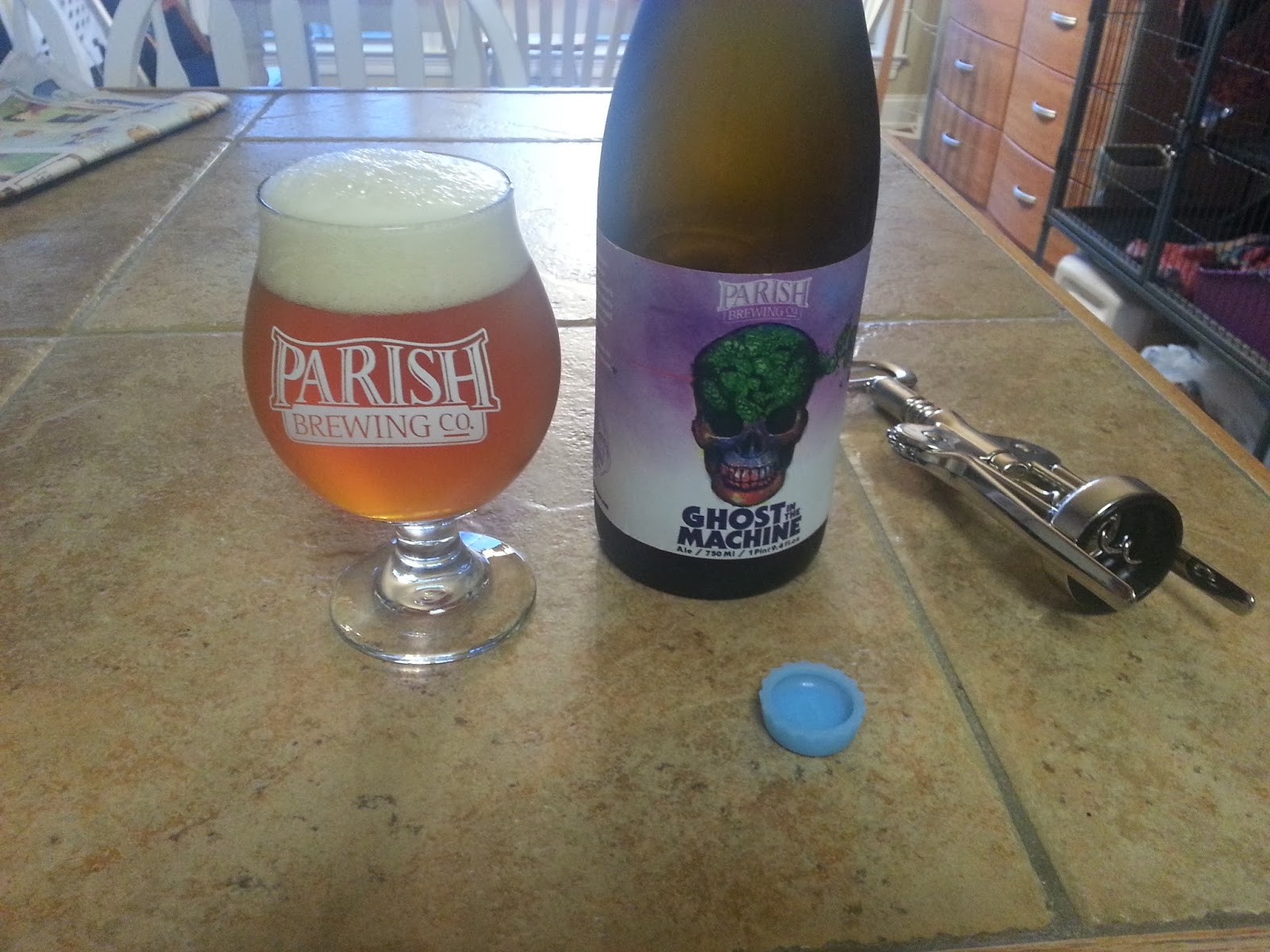
Aroma: Resiny pine up front with grapefruit in the background. A hint of woody and bready notes at the back end. A hint of warming alcohol. No other aromas come through initially, but there is some dankness that comes through after warming. A bit catty. 11/12
Appearance: Brilliant gold/orange with thick rocky white head. Good retention. Mix of a few medium and plenty fine bubbles with excellent lacing. 3/3
Flavor: Grapefruit with a little peachiness dominates. Resiny pine lingers with a hint of sweet bready malt keeping it honest and from becoming too harsh. A touch of warming alcohol is barely detectable. No diacetyl or other off flavors. 18/20
Mouthfeel: Medium-light bodied with a balance towards the dry side from the hops but not astringent. Just enough sweetness to keep it from being harsh. A little tingling from the carbonation and warming from the alcohol. No diacetyl slickness. 5/5
Overall Impression: This is really a fantastic beer. I'm not a huge hop head in general, but this is worthy of many of the American DIPAs that beer geeks go gaga over. 9/10
That puts it as a 46/50 in my book. Andrew really knocked it out of the park with this one in my opinion. Personally, I still prefer Grand Reserve and ICS hedonistically, but this beer may put Louisiana on the map among hop heads. It's not too hoppy for me.
Wednesday, January 29, 2014
Brooklyn Brewery Black Ops Review

I'm going to consider this a Russian Imperial Stout (category 13f) for review purposes.
Aroma: Bourbon barrel aroma dominates. Warm, woody, alcohol sweetness. Roasty malts start to come through next with chocolate, coffee, and cherry notes. No hop aroma, diacetyl, or other off flavors come through. Woody vanilla notes are still strong as it warms. 11/12
Appearance: Black as a SEAL or Marine Recon team coming after you. Opaque, but not hazy. Thick initial tan head with good retention. Texture of a foamy espresso with fine creamy looking bubbles lining the surface. Excellent lacing with alcohol legs. 3/3
Flavor: Bourbon barrel aging is obvious. Wood and bourbon are there. Roasty malt stands up and makes itself known. Slightly sweet, but certainly not cloying with enough hop bitterness to balance it out. Extremely pleasant alcohol warmth. No off flavors detected. 18/20
Mouthfeel: Full bodied with medium-low carbonation. Moderate alcohol warmth, but not hot or solventy. Chewy and velvety creaminess. Balance is slightly wet, but not overly cloying. No diacetyl slickness. 5/5
Overall Impression: Outstanding. The perfect beer for a winter's night. 9/10
That puts it at a 46/50 in my book. While I don't know if there are any perfect beers in the world, the only thing I can criticize about this one is that I don't have a case of it standing by to age.
Bayou Teche Loup Garou Review

I'm going to consider this a Foreign Export Stout (category 13d) for review purposes.
Aroma: Strong chocolate and coffee notes. Touch of tobacco. Warming alcohol aroma. Slight woodiness. No hop aroma to speak of. Very slight dark cherry-like esters. No diacetyl or other off aromas. Dark malty breadiness starts to present itself as it warms. 10/12
Appearance: Black as night. Just like its prey, no light escapes the Loup Garou. Opaque, but not hazy. Thick initial brown head with good retention. Texture of a good espresso with fine creamy looking bubbles lining the surface. 3/3
Flavor: Coffee and tabacco are prominent. Chocolate follows close behind with a touch of wood. Bitterness from roasted barley and hops are enough to balance the sweetness and lingers only slightly. Slight pleasant alcohol warmth. No off flavors detected. 17/20
Mouthfeel: Full bodied with medium carbonation. Slight alcohol warmth. Slight creaminess. Balance is slightly dry, but not astringent. No diacetyl slickness. 5/5
Overall Impression: An excellent beer. My new favorite beer from Bayou Teche. I don't get as much licorice flavor as I would have expected unless that's what contributed to the tobacco-like aroma and flavor. Regardless, a very pleasing beer. 9/10
That puts it at a 44/50 in my book. The only thing I can really fault them on is that I didn't get a whole lot of licorice character in the aroma. That being said, it's only a slight ding and this is certainly a great beer in my world.
Subscribe to:
Posts (Atom)